Epo Obo (Erun): Gbogbo Iwulo Epo Obo
“Àjẹ́ kì í jẹ́ Èpo Ọ̀bọ̀…
…Ẹyẹ kẹ́yẹ kan kì í jẹ́ èso wérénjéje.”
There are some Yoruba sayings that sound like praise until you think about what they are actually saying.
This is one of them.
Epo Ọbọ is being placed beside wérénjéje, the plant whose beautiful little seeds are not something you should mistake for ordinary food.
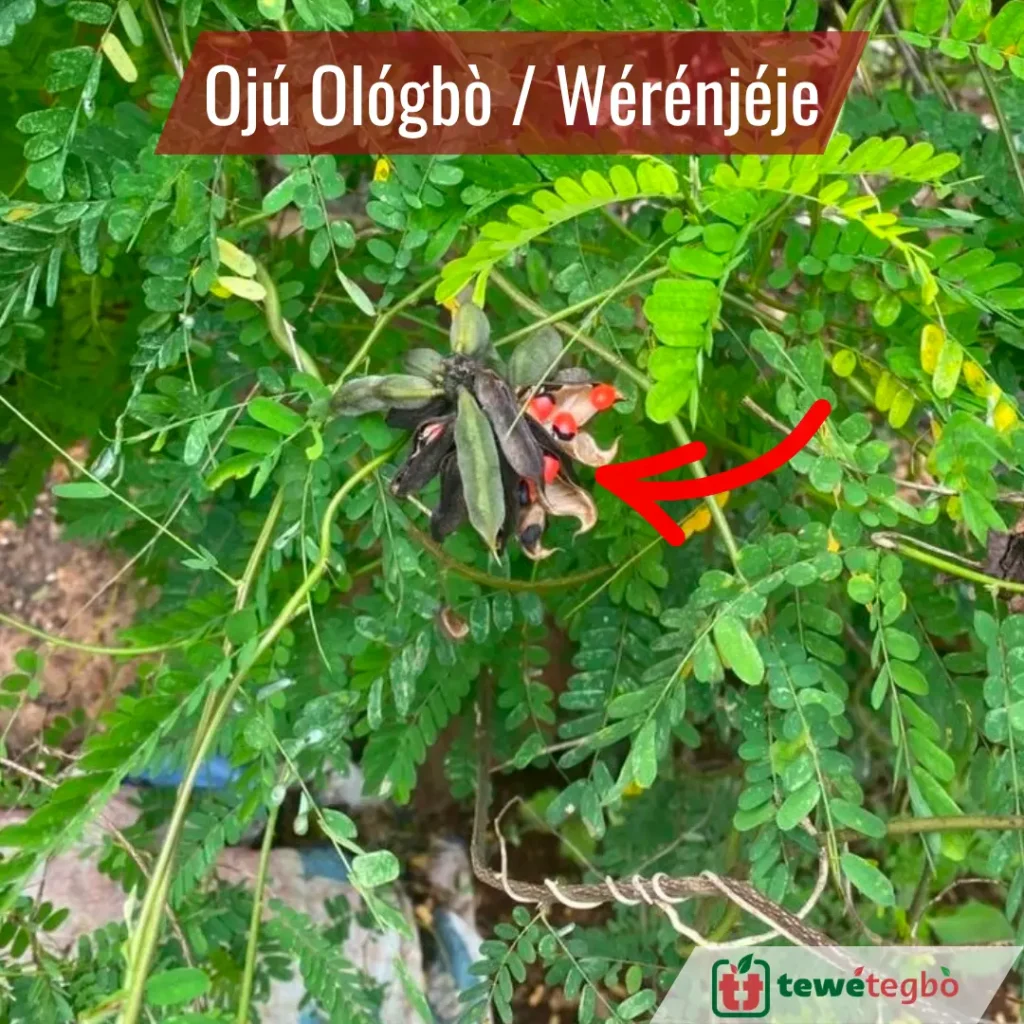
That is werenjeje above also known as ojú ológbò, owérénjéje
And look carefully at the first part.
Àjẹ́ kì í jẹ́ Èpo Ọ̀bọ̀.
No matter how powerful an Àjẹ́ (witch/wizard) may be, the saying says the person would not dare consume Èpo Ọ̀bọ̀.
That is not just praise for the power of Epo Ọbọ.
It is also a warning.
Because there is a difference between saying that something is powerful and saying that it is something you should put inside your body.
Our elders understood that difference.
And this is where Epo Ọbọ becomes very interesting.
Today, many people know Epo Ọbọ as one of those powerful herbs used traditionally for spiritual protection, cleansing and driving away evil forces.
And some have only seen the name online.
But there is a side of Epo Ọbọ that many people don't know.
It is not just an ordinary tree.
It was once used in traditional systems of justice, where a person's life could literally depend on what happened after they consumed an herb made from this tree.
That is how it came to be known in English as the:
Ordeal Tree.
And there is another problem.
Search for Epo Ọbọ today and you may find different trees being brought up under the same name.
So what exactly is Epo Ọbọ?
Why is it regarded as such a powerful herb?
Let us look at Epo Ọbọ from the beginning:
What Is Epo Ọbọ?
Epo Ọbọ is the bark of a particular tree that has been known in Yoruba herbal knowledge for generations.
The tree is called:
You may also come across the name Erythrophleum suaveolens when searching for it.
That is the correct scientific name.
Some people mistakenly attach it to a scientific name Ficus platyphylla,
That is a completely different tree.
But forget the grammars. That is not our business here.
There is something about Epo Ọbọ that many people don't even know.
There are two types of Epo Ọbọ.
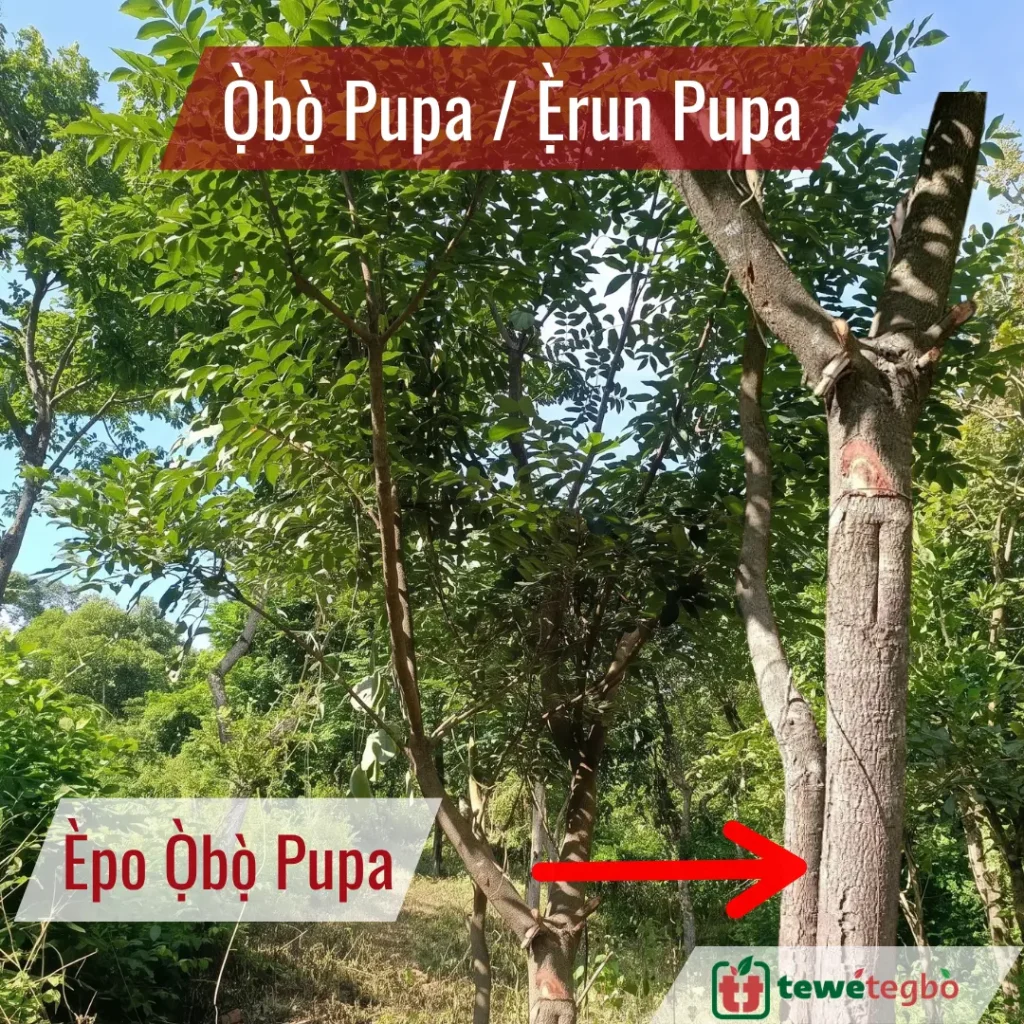
The one most people know is called Epo Ọbọ Pupa, also known as Erun Pupa.
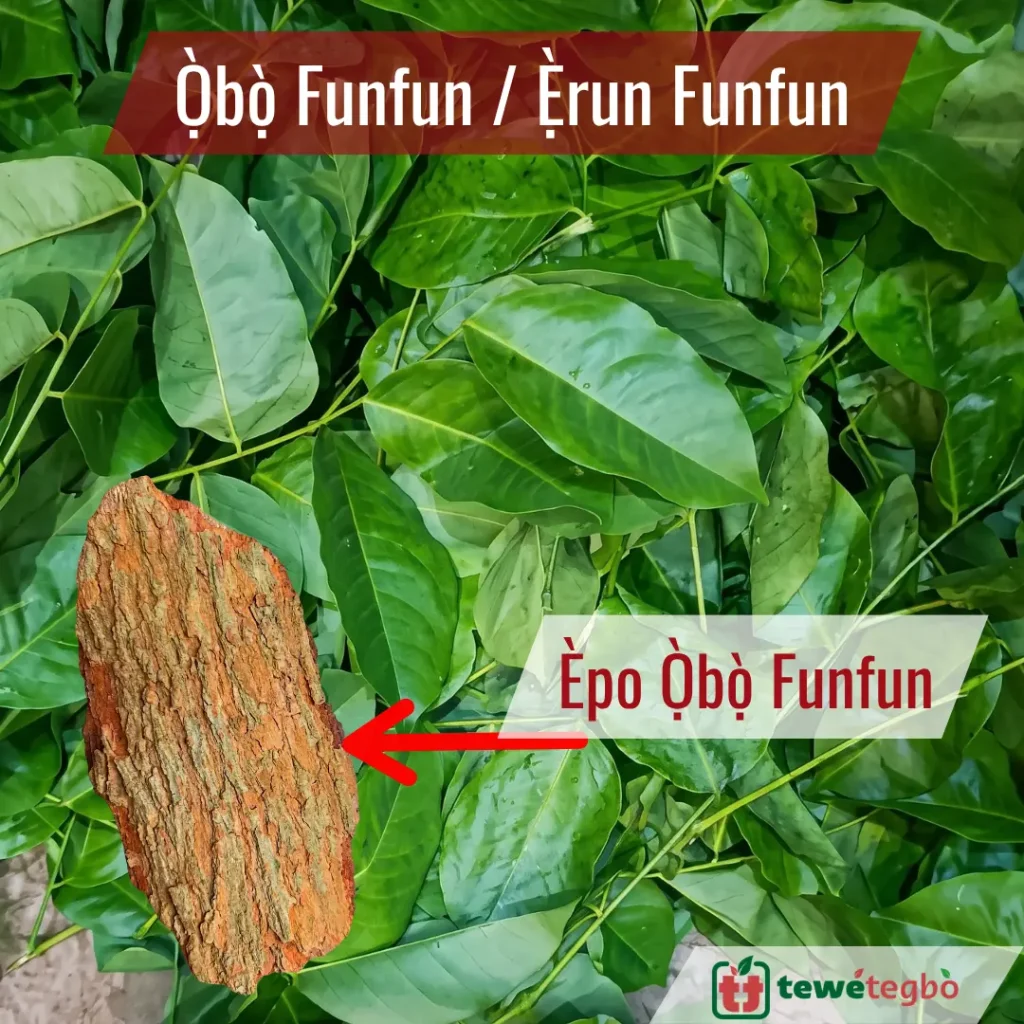
Then there is Epo Ọbọ Funfun, also called Erun Funfun.
The red one is the one you are much more likely to hear about.
Ask around in the herb market and many sellers will know Epo Ọbọ Pupa immediately.
But ask for Epo Ọbọ Funfun and you may get a different reaction.
Some sellers have never heard of it.
Some know the name but have never seen it.
And among those who know it, only a few of the older women who have spent many years around Yoruba herbs seem to recognize what you are talking about.
In fact, if you simply ask for Epo Ọbọ in the market, there is a good chance you will be given the red one.
Not necessarily because the seller is trying to deceive you.
It is simply the one that is commonly known.
The white variant is different.
It is not widely seen today, and some people even argue that it does not exist.
I understand why.
If something has not been seen by most people for a very long time…
…and only a few older people still talk about it…
…it is easy for the next generation to conclude that the thing never existed in the first place.
But this is one of those cases where I cannot speak only from what I just heard from someone.
I have seen Epo Ọbọ Funfun myself.
And in the traditional knowledge, it is regarded as an even more powerful than the commonly known Epo Ọbọ Pupa.
That makes the white variant particularly interesting.
Because we are not simply talking about two names for the same thing.
We are talking about a distinction within Yoruba herbal knowledge that is already becoming difficult to find.
And may be that is why so few people know about it today.
When knowledge is passed from one generation to another mainly through people, anything that is rarely seen can eventually disappear from common knowledge.
The older people who knew it may still remember it.
But if the younger generation never sees it, the knowledge stops travelling.
So, before we go further, remember this:
Epo Ọbọ Pupa is the commonly known type. Epo Ọbọ Funfun is the much less commonly known type.
And if you have only ever heard of Epo Ọbọ Pupa, you are not alone.
There is another reason Epo Ọbọ is even more confusing today.
Search for the name online and you may find a completely different tree being called Epo Ọbọ.
That is another confusion created on the internet.
Epo Obo In English
In English, Epo Ọbọ is called the Ordeal Tree.
Some people also call it Anti-Witchcraft Bark, Sasswood, or simply Sassy Bark.
And because of what it does to the body, some call it the Red Water Tree.
Why Is Epo Obo Called Erun?
There is another name for Epo Ọbọ that tells you a lot about how our elders viewed this tree.
Erun
The word erun literally means “destroyer.”
That is not a random name.
According to the traditional understanding passed down by the elders…
…the earlier generations gave the tree this name because they observed its ability to destroy the person who consumed it (for internal use).
Think about that for a moment.
Our ancestors did not know the chemical names of the compounds inside the tree.
They did not have laboratories where they could run test.
But they could observe.
They could see what happened when people came into contact with certain plants.
And when a plant repeatedly showed itself to be capable of destroying its consumer (when used internally)
This also helps us understand the old Yoruba saying:
Àjẹ́ kì í jẹ́ Epo Ọbọ.
But Is Epo Ọbọ ONLY Dangerous to Àjẹ́ Witch/Wizard?
There is an interesting misunderstanding I have seen around the old saying:
“Àjẹ́ kì í jẹ́ Èpo Ọ̀bọ̀.”
Some people now interpret it to mean that you should make sure you are not an Àjẹ́ before using Epo Ọbọ (internally).
I have even seen social media posts warning people, in essence, to make sure they are not witches before using it.

But think about the original saying again.
“Àjẹ́ kì í jẹ́ Epo Ọbọ.”
It does not say that Epo Ọbọ is dangerous only to an Àjẹ́.
The saying is presenting Epo Ọbọ as something so formidable that even an Àjẹ́ would not dare consume it.
That is a very different message.
In another post on the internet, someone confidently told people that Epo Ọbọ could be chewed.
Then somebody commented underneath and challenged the claim.
Explaining that they had almost suffered serious consequences after someone added Epo Ọbọ to beans by accident.
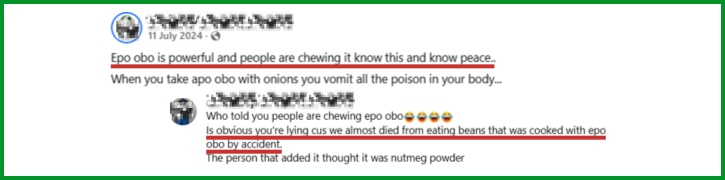
Now, look at what has happened.
One person is treating Epo Ọbọ almost like an ordinary herbal remedy.
Another is interpreting the old saying as a warning specifically for witches.
And another person's real-life experience is telling us:
“Please don't treat this thing casually.”
This is exactly why old knowledge needs to be understood, not merely repeated.
The proverb was not necessarily telling you to check whether you are an Àjẹ́ before touching Epo Ọbọ.
It was emphasizing the power associated with the bark.
And remember the other name:
Erun.
Destroyer.
It also has a praise:
“Jẹ tán kí n gbọ́ igbe” – eat it, I'll wait for the screaming.
It's used sarcastically or as a warning encouraging (or mockingly “daring”) someone…
…to go ahead and eat something risky, with the implication that they'll soon be crying out in pain or regret afterward.
It's not genuine praise; it's a warning dressed up as encouragement.
When you put the name, the proverb and the traditional understanding beside each other, the message becomes much clearer.
It is praise.
But it is also a warning.
You can describe something as powerful without telling people to consume it.
In fact, sometimes the strongest praise is itself the warning.
And that is what makes this old saying so interesting.
Our elders could encode an entire warning into one sentence.
Traditional Medicinal Uses of Epo Ọbọ
Epo Ọbọ is not known only for its spiritual reputation.
In Yoruba herbal knowledge, it has also been used traditionally for a number of physical conditions.
Here are some of the traditional medicinal uses associated with Epo Ọbọ.
Epo Ọbọ for Ìdí Yíyo (Prolapsed Rectum)
Ìdí Yíyo is the Yoruba name commonly used for a condition in which part of the rectum protrudes outward.
Epo Ọbọ has traditionally been used in external preparations for this condition.
In the traditional method, the bark is prepared with other materials and used externally around the affected area.
Epo Ọbọ for Ìgbẹ́ Ẹ̀jẹ̀ (Bloody Stool)
Another traditional use of Epo Ọbọ is for Ìgbẹ́ Ẹ̀jẹ̀, meaning bloody stool.
In Yoruba herbal practice, Epo Ọbọ has been used externally as part of traditional treatment for this condition.
Bloody stool, however, can have many different causes.
So while this is an established traditional use in the knowledge being documented here, identifying the underlying cause remains important.
Epo Ọbọ for Cancer of the Anus
Epo Ọbọ is also traditionally used for what Yoruba refers to as jejere ojú ìdí, or cancer of the anus.
This is one of the conditions for which Epo Ọbọ has been used traditionally.
Epo Ọbọ for Skin Infections and Body Rashes
Epo Ọbọ is also traditionally used for skin infections and body rashes.
For this purpose, it is traditionally combined with other herbal ingredients and used externally.
This is another example of something that is easy to miss if Epo Ọbọ is discussed only in connection with its spiritual reputation.
It has a place in traditional Yoruba knowledge of physical ailments too.
An Important Difference
There is something worth noticing about these traditional uses.
The Epo Ọbọ preparations described in this tradition are external applications.
That is very different from treating Epo Ọbọ as an ordinary edible herb.
And this brings us back to something we discussed earlier.
When our elders gave this bark the name Erun (Destroyer)
Epo Ọbọ has a long history in Yoruba herbal knowledge.
But its medicinal reputation is only one part of that history.
There is another side that many people know even more strongly:
its spiritual use.
The Spiritual Use of Epo Ọbọ
There is another side of Epo Ọbọ that cannot be separated from its history in Yoruba herbal knowledge.
Its spiritual use.
Among people who understand Epo Ọbọ traditionally, the bark is not regarded only as something for physical ailments. It is also associated with spiritual well-being.
It may be used traditionally for spiritual cleansing, especially when someone is believed to be carrying a negative spiritual influence.
It is also associated with situations believed to involve witchcraft or spiritual attacks, as well as other forms of evil influence.
This is part of the traditional knowledge surrounding Epo Ọbọ, and it is one of the reasons the bark has such a powerful reputation among those who know it.
But there is something I want to make clear.
You will find people online talking about Epo Ọbọ as Àsìnà Owó (a “wealth puller”) and making similar claims about money, favour and success.
We don't rush to say that.
A plant does not manufacture wealth.
God is the One who gives wealth, favour and provision, and He gives them at their appointed time.
So when a plant is traditionally used for spiritual well-being, that does not mean the plant itself creates blessings.
The traditional understanding is closer to the idea that certain plants were created by God with particular abilities that can help address spiritual disturbances.
If a person is believed to be experiencing a spiritual attack or negative influence, the traditional use of Epo Ọbọ may be understood as part of dealing with that disturbance.
That is very different from saying:
“Use Epo Ọbọ and money will start coming.”
No.
You still have to work.
You still have to use wisdom.
You still have to have good character.
You cannot refuse to work and expect wealth to appear because you used an herb.
You cannot behave badly towards people and expect a plant to manufacture favour for you.
And you cannot turn a plant into the source of what belongs to God.
This is why I prefer to describe Epo Ọbọ in terms of spiritual well-being, cleansing and dealing with spiritual disturbances, rather than reducing its traditional reputation to a “wealth herb.”
There is much more to Epo Ọbọ than that.
Epo Ọbọ and the Ordeal Story
There is another story about Epo Ọbọ that is sometimes mixed up with the Yoruba story.
You may hear people say that Epo Ọbọ was used to find out whether someone was a witch.
But we need to be careful with this.
The tree from which Epo Ọbọ comes is called the Ordeal Tree in English.
Its bark was used in some parts of Africa for what was called a trial by ordeal.
What does that mean?
It means that when someone was accused of a serious crime, the person could be made to take a certain substance such as epo obo.
People believed that what happened to the person would show whether the person was guilty or innocent.
In some places, this was also used when someone was accused of witchcraft.
But this is very important:
Just because the tree was used this way in some parts of Africa does not mean that the Yoruba used Epo Ọbọ in exactly the same way.
In Yoruba tradition, Epo Ọbọ is more strongly connected with protection and driving away evil or harmful spiritual forces.
So the idea is not necessarily:
“Give Epo Ọbọ to this person and see if they are a witch.”
It is more like:
“Witches and evil forces are believed to fear Epo Ọbọ, so Epo Ọbọ can be used to keep them away.”
This helps us understand the old saying:
Àjẹ́ kan kì í jẹ́ Epo Ọbọ.
An Àjẹ́ does not eat Epo Ọbọ.
Notice the difference.
It does not mean:
“Give Epo Ọbọ to anybody you suspect of being an Àjẹ́.”
Those are two different things.
The first says that an Àjẹ́ is believed to avoid Epo Ọbọ.
The second says that Epo Ọbọ is used to test whether someone is an Àjẹ́.
The Yoruba understanding I am talking about here is much closer to the first idea.
This also agrees with the name Erun, meaning “destroyer.”
If the elders believed that Epo Ọbọ could destroy the person who swallowed it, it would not make much sense to use it casually as a way of testing people.
Its role is better understood as something that drives away or protects against what is believed to be spiritually harmful.
And this is an important point.
When stories move from one place to another, people can easily take something that happened in one African community and say that it was also the exact practice of another community.
But Africa is not one culture.
The Yoruba have their own history, beliefs and knowledge.
So when we talk about Epo Ọbọ, we should also allow the Yoruba understanding of it to stand on its own.
Is Epo Ọbọ Poisonous?
This is probably one of the first questions that comes to mind after everything you have read about Epo Ọbọ.
So, is Epo Ọbọ poisonous?
The short answer is: Epo Ọbọ is not safe for certain forms of use, especially internal use such as drinking or eating.
But even that answer needs some explanation.
In herbal medicine, saying that a plant is “poisonous” can sometimes give the wrong impression…
…as if the entire plant, in every form and under every circumstance, is simply poison.
That is not how herbal knowledge works.
There is a difference between a plant having poisonous properties and saying that the plant is nothing but poison.
Think about hot water.
If someone gives you water straight from the fire and says:
“Drink it.”
You wouldn't put it into your mouth immediately.
Not because the water itself is poisonous.
It is because the water is too hot to consume at that moment.
You allow it to cool until it reaches a condition in which you can safely drink it.
Herbs can also have different forms, parts, stages and preparations that matter when we talk about how they are used.
That is why simply saying “Epo Ọbọ is poisonous” does not tell the whole story.
The more important question is:
Poisonous in what form, which part, and being used how?
I explained this properly in Can Agbo Herbs Be Poisonous?, including why the form of a herb, the part being used, its preparation and the way it is intended to be used all matter.
What We Should Remember About Epo Ọbọ
There is a reason I wanted to write about Epo Ọbọ.
Today, you can find a lot of information about it.
But some of the old knowledge about Epo Ọbọ is getting mixed up.
There is Epo Ọbọ Pupa.
There is also Epo Ọbọ Funfun, which many people do not even know about today.
There is the name Erun, which means “destroyer.”
There is also the old saying:
“Àjẹ́ kì í jẹ́ Epo Ọbọ, ẹyẹ kẹ́yẹ kan kì í jẹ́ ẹ̀sọ̀ wẹ́rẹ́njẹ́jẹ́.”
Majorly used externally.
There are also the traditional spiritual uses.
And there is the long history of this important tree.
But today, some of these things have been separated from each other.
For example, a Yoruba name may be given to a different plant.
A proverb may be explained in a way that is different from what our elders meant.
Something that was once used in a certain way may become a very different story on the internet.
Then people start copying the same information from one person to another without checking it.
That is why the name matters.
And when we are talking about herbs, knowing the right plant matters even more.
Knowing the name alone is not enough.
We need to know which plant that name belongs to.
We need to understand what our elders were actually saying.
And sometimes, we need to go back and speak with people who still remember the old knowledge.
That is the kind of knowledge we should keep.
But we should not believe everything simply because it is old.
And we should not reject everything simply because it is traditional.
We should also not believe everything just because we see it on the internet.
First, understand it.
Then you can decide what is true, what needs more checking, and what should be passed on.
That is how we keep our knowledge alive.
Frequently Asked Questions About Epo Obo
Can Epo Ọbọ be eaten or drunk?
No. Epo Ọbọ should not be eaten or drunk like an ordinary herb.
Is Epo Ọbọ used for wealth or favour?
The traditional spiritual understanding discussed here is that Epo Ọbọ may be used in dealing with spiritual disturbances or negative influences.
It is not regarded as a plant that manufactures wealth or creates favour.
Wealth and provision ultimately come from God, while a person's effort, wisdom, character and actions still matter.
Why is Epo Ọbọ associated with Witch (Àjẹ́)?
The Yoruba saying “Àjẹ́ kan kì í jẹ́ Epo Ọbọ” is one reason for this association.
The saying presents Epo Ọbọ as something that even an Àjẹ́ would not dare consume.
It is therefore better understood as an expression of the formidable reputation of the bark than as a statement that Epo Ọbọ is only dangerous to witches.
Chat me Now on WhatsApp about Bomubomu
Not sure if Bomubomu will work for you?
Send me a WhatsApp message now, I’ll guide you.
Let me reconnect you to the nature’s pharmacy.