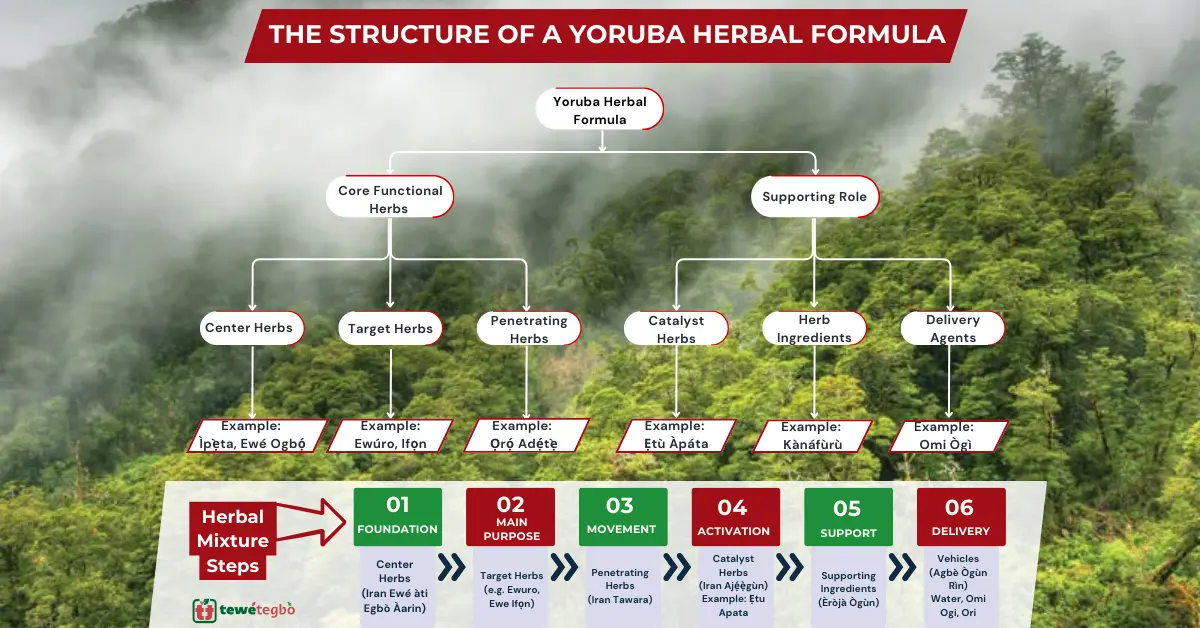
Agbo is a traditional Yoruba herbal mixture made by combining different plant ingredients such as leaves, roots, and bark.
It is usually prepared by soaking or boiling these herbs in water.
Agbo is not a random mix of plants.
Every plant added to agbo has a role and a reason for being there.
In Yoruba herbal medicine, a single plant is rarely used alone in herbal remedies.
Instead, several plants are often combined to prepare one remedy.
In these mixtures, each herb may serve a specific purpose.
Some herbs help strengthen the body.
Some help remove waste or toxins.
Others help make the remedy work better.
Because of this, herbs are understood not only by the type of plant they are, but also by the role they play in the mixture.
In Yoruba herbal tradition, a herbal mixture (agbo) is sometimes described like a team working together.
- Some herbs guide the direction of the remedy
- Some activate the healing effect
- Some remove obstacles in the body
- Some support and strengthen the body
This understanding helps herbal practitioners decide:
- Which herbs to combine
- Which herb should lead the mixture
- Which herbs should support the main action
As a result, Yoruba herbal practice often groups herbs by the role they play in a herbal mixture, not only by their individual properties.
How To Prepare Agbo Herbal Mixture (Chart)
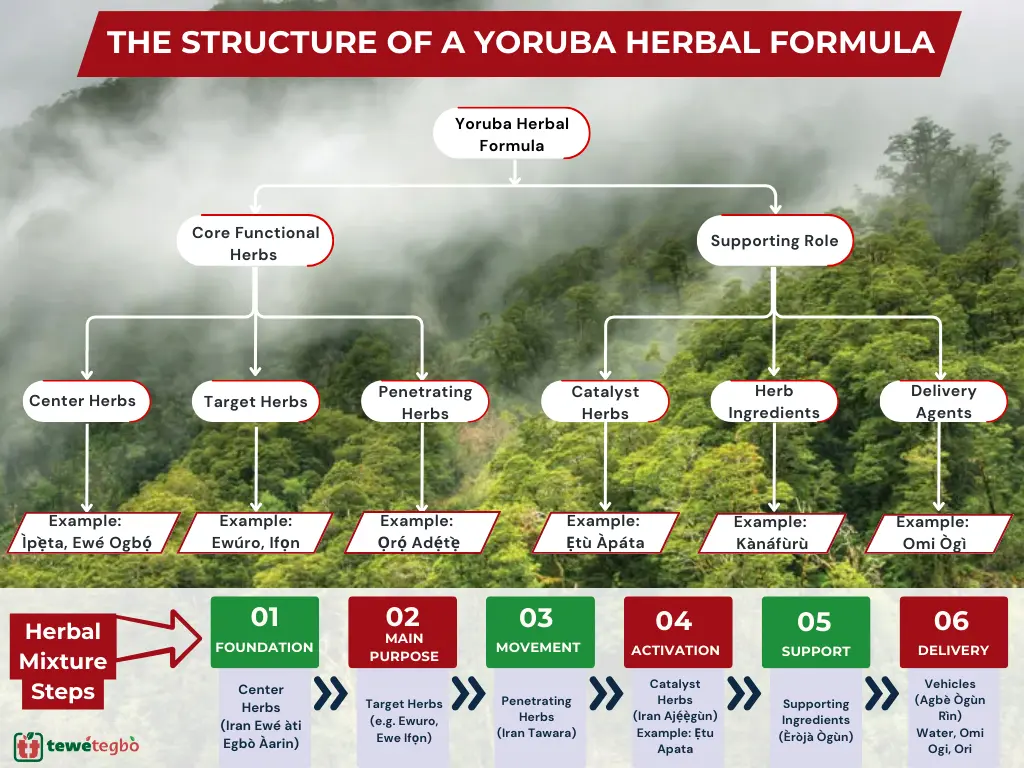
Major Categories of Herbs (Agbo) in Yoruba Herbal Medicine
The categories below represent common functional roles traditionally attributed to herbs in Yoruba herbal mixtures.
1. Iran Ewé àti Egbò Àárín
(Center Herbs)
Example: Ìpẹ̀ta — Securidaca longipedunculata
In Yoruba herbal tradition, some herbs are described as center herbs.
These herbs are believed to act like middle agents within a herbal mixture.
Unlike herbs that have a strong fixed direction, center herbs are considered adaptable. Their role is often shaped by the other herbs combined with them.
Traditional practitioners sometimes say these herbs receive instruction from the other ingredients in the mixture.
In this way, the surrounding herbs guide the center herb on what action the remedy should focus on.
For example:
- If Ewuro (Bitter leaf) is added to Ipẹta, the mixture may traditionally be used to help regulate internal balance such as blood pressure.
- If Ewe Ifọn (Olax subscorpioidea) is added, the preparation may be used to support relaxation or restful sleep.
- If Turmeric is added, the mixture may be used in preparations associated with liver cleansing or detox support.
In this concept, the center herb functions like a mediator, helping coordinate the action of the herbal formula.
Another example is Ewe Ogbọ́
It is described as center herb too.
This is why Yoruba elders sometimes express this idea through the saying:
“Ohun a wí fún Ọgbọ́ ni Ọgbọ́ n gbọ́.”
What you tell Ogbo to do, it listens.
In medicinal interpretation, this does not imply magic. Instead, it reflects the idea that ewe ogbo has broad compatibility, allowing them to blend easily with other ingredients and help the mixture work better.
For this reason, center herbs are often viewed as foundation herbs in many traditional herbal preparations.
2. Iran Ajẹ́ẹ̀gùn
(Catalyst Herbs)
Example: Ẹtù Àpáta
In Yoruba herbal medicine, some ingredients are added not because they are the main cure, but because they activate and strengthen the herbal mixture.
These are called Iran Ajẹ́ẹ̀gùn, often described as catalyst herbs.
Their role is to help other herbs work more effectively.
Traditional practitioners believe that in some cases, an illness may become deep-rooted, stagnant, or resistant. When this happens, herbs alone may move slowly in the body.
Ajẹ́ẹ̀gùn herbs are added to bring movement and activation to the preparation.
They are believed to:
- awaken the action of other herbs
- enhance the potency of the mixture
- help the remedy act more forcefully
One well-known example associated with this role is Ẹtu Apata, a substance traditionally described as a dark mineral found inside mountain rocks.
Yoruba wisdom expresses its power through a proverb:
“Ti apata ba ni ẹtu ninu, bi o lo ẹgbẹrun ọdun laye, yio la ina ni ọjọ kan.”
Meaning:
If a mountain carries gunpowder within it, even after a thousand years, one day it will spark fire.
The proverb illustrates the idea of hidden potential waiting to be activated.
In herbal interpretation, Ẹtu Apata represents ignition — the force that helps a remedy overcome stubborn resistance.
Because of its perceived strength, such catalyst ingredients are traditionally used with care and are not added casually to herbal preparations.
2. Iran Ewé Ara
(“Miraculous” Herbs)
Examples:
- Abamoda (Miracle leaf)
- Ewe Alupaida – Urera picta
These herbs are often described as ewé ara, meaning herbs that appear to act in ways that seem surprising or extraordinary.
In traditional belief, these herbs can produce results that feel almost miraculous when used correctly.
4. Iran Tawàrà
(Penetrating Herbs)
Example: Ọrọ́ Adẹ́tẹ̀
This group includes herbs that have a sharp, hot, or pepper-like quality.
Examples of similar ingredients may include:
- Iyere (Black Pepper)
- Atare (Alligator pepper)
These herbs are traditionally believed to:
- Act quickly
- Penetrate deeply into the body
- Break stagnation
- Produce a noticeable sensation or response
Because of this quality, they are sometimes used to help remedies move faster in the body.
5. Iran Aporó / Ẹ̀rọ̀ / Apàrùn
(Symptom Silencers)
Example: Adi Eyan or Adi Dudu – Palm Kernel Oil from the oil palm tree.
These herbs or ingredients are believed to calm or weaken the symptoms of illness.
Traditional practitioners say they help clear the path for other herbs in the mixture to work more effectively.
In other words, they may reduce disturbance before stronger herbs act.
6. Iran Olójú Éjì
(Stabilizing or Normalizing Herbs)
Example: Ewuro – Bitter leaf
These herbs are believed to help the body return to balance.
Traditional thinking often describes them as herbs that “normalize” body conditions.
For example, bitter leaf is sometimes traditionally used in situations involving imbalance such as:
- High or low blood pressure
- High or low sugar levels
The goal is to help restore equilibrium in the body.
7. Iran Afọ Ìdọ̀tí Ara
(Flushing Herbs)
Example: Bàrà Ẹ̀gúsí
These herbs are used when the goal is to remove internal waste or buildup.
They are believed to help the body:
- Expel waste
- Clean internal systems
- Remove unwanted substances
In modern language, people sometimes compare this idea to detoxification, although traditional concepts may differ.
8. Iran Àjẹsára
(Immunity and Strength Boosters)
Example: Epo Ogano, Oganho or Oganwo – Mahogany
These herbs are traditionally used to strengthen the body.
Their purpose is to help the body become more resilient and better able to resist illness.
In simple terms, they help build the body’s natural defense system.
You can think of them as herbs that help build the body’s “soldiers.”
9. Èròjà Ògùn
(Supporting Herbal Ingredients)
Examples include:
- Kanafuru (Clove)
- Atare (Alligator pepper)
- Iyere (Black Pepper)
- Booni (Acacia nilotica seeds)
These are supporting ingredients used in herbal mixtures.
They are usually not the main herb in the remedy.
Instead, they help by:
- Supporting the mixture
- Improving taste
- Enhancing effectiveness
- Complementing the main herbs
They play a role similar to spices in cooking.
10. Agbè Ògùn Rìn
(Herbal Vehicles / Carriers of Medicine)
In Yoruba herbal practice, remedies are often prepared with certain substances that help the herbs mix, dissolve, or be applied properly.
These substances are known as Agbè Ògùn Rìn, meaning the medium through which the medicine travels.
They are not usually the main healing herbs themselves. Instead, they serve as vehicles that carry or deliver the medicine.
Agbè Ògùn Rìn help herbal preparations to:
- mix properly
- reach the body effectively
- be applied in the correct form
Traditional herbal preparations may use different vehicles depending on how the remedy is intended to be used.
Common examples include:
- Water (Omi) – often used for soaking, boiling, or mixing herbs
- Fermented corn water (Omi Ogi) – sometimes used in gentle preparations
- Shea butter (Ori) – commonly used for herbal ointments and external applications
- Water from another cooked herb are used in some rare cases.
In this way, Agbè Ògùn Rìn act as the carriers that allow herbal medicines to be prepared and delivered effectively.
Categories of Agbo (Herbs) at a Glance
| Yoruba Category | Meaning | Example Herb | Traditional Role |
|---|---|---|---|
| Iran Ewé àti Ẹ̀gbò Àárín | Center herbs | Ipẹta | Guides and coordinates herbal mixtures |
| Iran Ewé Ara | Miraculous herbs | Abamoda | Traditionally believed to produce powerful results |
| Iran Tawara | Penetrating herbs | Oro Adete | Acts quickly and breaks stagnation |
| Iran Aporo / Ero | Symptom silencers | Palm kernel oil | Weakens symptoms before deeper treatment |
| Olójú Éjì | Stabilizing herbs | Bitter leaf | Helps restore body balance |
| Iran Ajẹ́ẹ̀gùn | Catalyst herbs | Etu Apata | Activates and strengthens mixtures |
| Iran Afo Idọti Ara | Flushing herbs | Bara | Helps remove waste from the body |
| Iran Àjẹsára | Strength herbs | Epo Ogano | Supports body resilience |
| Èròjà Ògùn | Supporting ingredients | Clove, Alligator pepper | Assist the main herbs |
| Agbè Ògùn Rìn | Carriers of herbs | Water, Fermented corn water | Transport the herb to the target |
How Agbo Is Made (Simple Steps)
Agbo is made by mixing selected herbs with water to bring out their strength.
People may prepare it in different ways, but it usually follows these steps:
Step 1: Choose herbs
Select herbs based on their roles in the mixture
Step 2: Wash herbs
Wash and prepare the plant materials
Step 3: Boil or soak
Boil or soak the herbs in water or any other herbal carrier
Step 4: Let it cool
Allow the mixture to cool or settle
Step 5: Drink/use
Use the preparation in the intended form
Example: How Is Agbo Prepared (Traditional High Blood Pressure Context)
To better understand how these categories work together, let us look at a simplified example based on a condition traditionally associated with blood pressure imbalance (high or low).
This example shows how a practitioner may select herbs based on their roles within a mixture.
Step 1: Choose a Center Herb
(Iran Ewé àti Egbò Àárín)
A center herb may be selected to act as the coordinating agent of the mixture.
Example:EgbòÌpẹ̀ta
It may be prepared first (for example, boiled and allowed to cool), forming the base of the mixture.
Step 2: Add a Target / Stabilizing Herb
(Iran Olójú Éjì)
Next, a herb is selected based on the intended purpose of the preparation.
Example: Ewuro (Bitter leaf)
In Yoruba traditional understanding, ewuro is often associated with helping the body regulate internal balance, especially in conditions linked with blood pressure.
Because of this, it may be selected in such preparations.
Fresh leaves may be squeezed into the prepared Ipẹta base.
Step 3: Add a Penetrating / Supporting Ingredient
(Iran Tawàrà + Èròjà Ògùn)
A warming ingredient may be added to help the mixture act more effectively.
Example: Alligator pepper (Atare)
It may be chewed alongside the mixture or added in powdered form.
This step is optional, depending on the intended strength of the preparation.
Step 4: Use a Vehicle
(Agbè Ògùn Rìn)
The mixture is then prepared using a suitable medium.
In this case:
The liquid from the boiled Ipẹta serves as the vehicle
Why Some Categories Were Not Used
In traditional practice, not all herb categories are included in every preparation.
Each decision depends on the situation.
For example:
Key Insight
Nothing in this type of preparation is selected randomly.
Each herb is chosen based on:
- its role
- its interaction with other herbs
- the intended purpose of the mixture
This reflects a structured traditional approach, where herbal formulations are built with clear reasoning and purpose.
Herbs are combined with specific roles and purposes, allowing them to work together as a coordinated system.
Understanding these traditional roles helps us appreciate the structure and wisdom behind Yoruba herbal knowledge.
Common Types of Agbo in Nigeria
In Yoruba tradition, different agbo are made for different problems.
People usually name them by what they are used for.
Here are some common types of agbo:
1. Fever & Infectious Diseases
2. Blood & Internal System
3. Digestive & Stomach
4. Neurological & Convulsion
5. Pain & Body Conditions
6. Throat & Respiratory
7. Dental & Oral Health
8. Circulation
9. Sexual & Reproductive Health
10. Metabolic & Weight
11 . Skin & External
12. Liver, Kidney & Organ Conditions
Explore More Yoruba Herbal Knowledge
Yoruba herbal medicine is a wide and structured system.
This guide explains how herbs are classified by their roles in a mixture.
To understand the full picture, you can explore these related guides: