

Parts of Plants Used in Yoruba Herbs (Agbo)
In Yoruba herbs (agbo), we do not just cut any part of a plant and call it medicine.
Our fathers taught us something important:
A tree is like a human body.
The head does not do the work of the leg.
Every part of a plant has its own work.
The leaf does not behave like the root.
The bark is different from the seed.
If you use the wrong part, the herb may:
- Not work well
- Work too slowly
- Or be too weak
That is why herbal knowledge is not guesswork.
Let us now look at the main parts of plants used in Yoruba herbs.
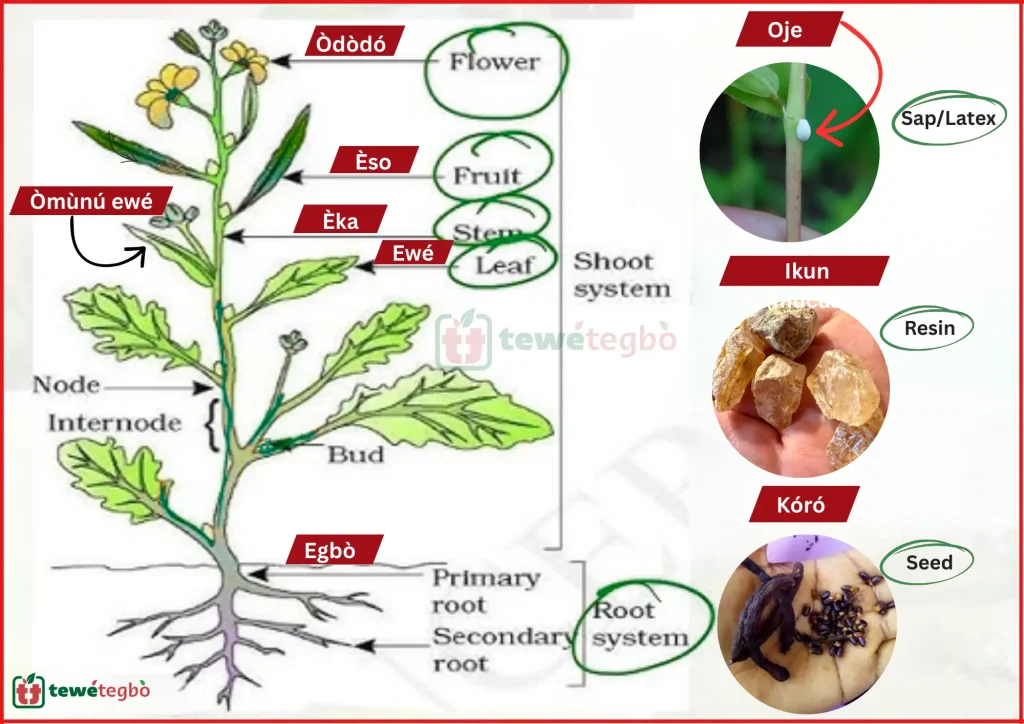
1. Leaves (Ewe)
Leaves (ewé) are the most common part we use.
They grow back fast and are easy to collect.
Sometimes the young leaf (ọ̀mùnú ewé) is required for a specific herb.
Young leaves can be softer and milder. Example of that is omunu ewe gedu
How we use leaves:
- Boil them to drink (Agbo)
- Use them for bathing
- Squeeze fresh leaves to get the juice
2. Bark (Epo Igi)
The bark (èpo igi) is the skin of the tree.
It is strong and holds power for a long time.
How we use it:
- Soak in water
- Soak in local gin
- Boil for strong Agbo
Warning:
Never remove bark round the whole tree.
If you do, the tree will die.
Always take small piece from one side.
3. Roots (Egbo/Gbongbo)
Roots (egbò) stay inside the ground.
They drink directly from the earth.
Because of this, roots are often used for:
- Deep sickness
- Long sickness
- Stubborn problems
Be careful:
Removing roots can kill the plant.
Only take when necessary.
4. Flowers (Òdòdó)
Many people forget flowers.
But flowers are also used.
Example:
- The flower of Asunwon Oyìnbo (Ringworm Bush/Candle Bush) is used in some herbs.
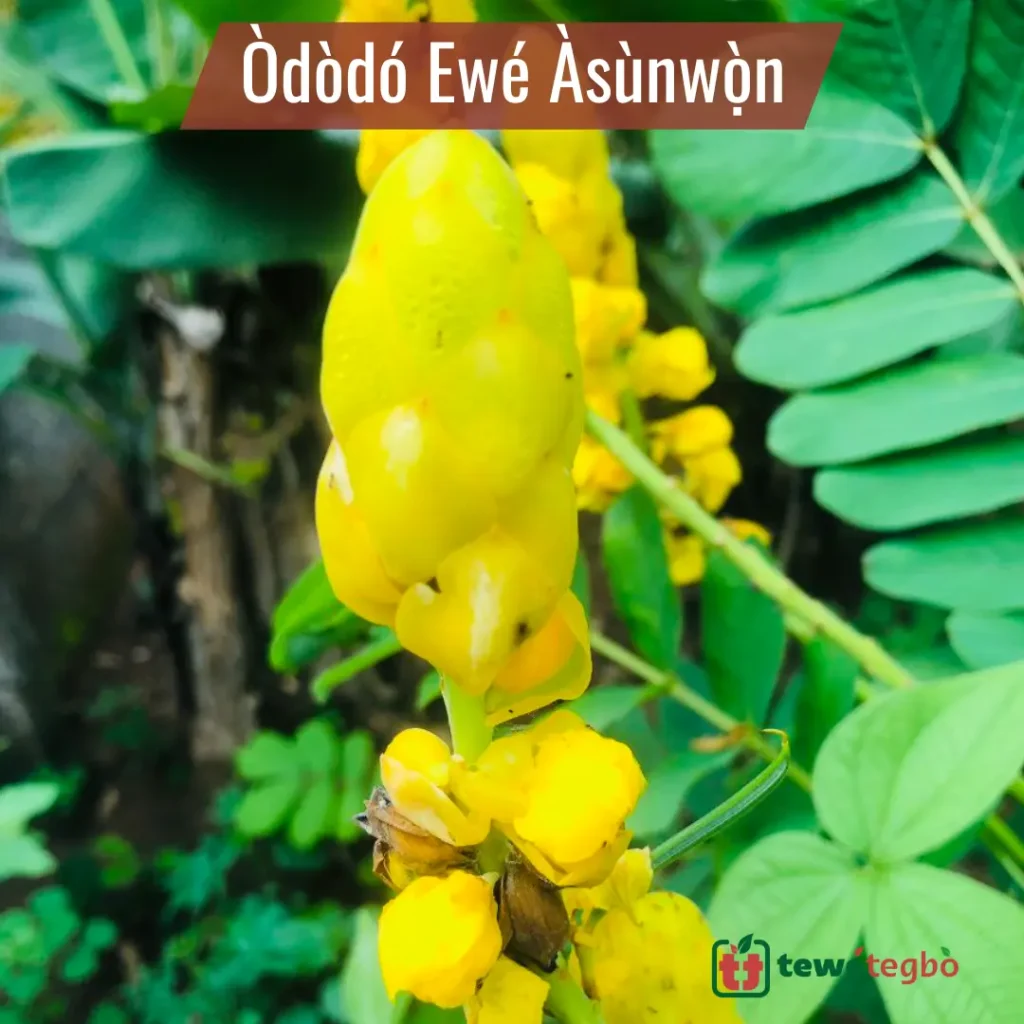
Flowers may be used for:
- Skin remedies
- Special herbal mixtures
- Spiritual preparations
5. Fruits (Eso)
Fruit (èso) is the part that grows after the flower.
It carries the seed inside.
Some fruits are used fresh.
Some are dried before use.
How we use fruits:
- Eat directly for health
- Boil in herbal drink (agbo)
- Pound and mix with other herbs
- Use the juice
Some fruits help digestion.
Some help the blood.
Some help the skin.
6. Seeds (Koro)
Seed (kóró) is the life inside the fruit.
Seeds are often stronger than the fruit.
Many seeds contain oil.
How we use seeds:
- Grind into powder or
- Extract oil
Because seeds are powerful,
they must be used carefully.
7. Stem (Eka Igi)
The stem (ẹ̀ka) is the main body/branch of the plant.
It connects:
- The root
- The leaves
- The flowers
- The fruits
It carries food and water inside the plant.
How Stem Is Used
Some herbs use:
- Young stems
- Small branches
- Soft stems (especially in small plants)
Stems may be:
- Boiled
- Soaked
- Pounded
In small plants like bálẹ̀rẹ́ (ground herbs), the whole plant may be used, including the stem.
8. Oje (White Plant Milk/Sap/Latex)
When you cut some plants, white milk comes out.
This is called Oje.
It flows quickly like milk.
Examples:
- Ọrọ́ Adẹ́tẹ̀ (Euphorbia unispina)
- Ìbẹ́pẹ́ (Pawpaw)
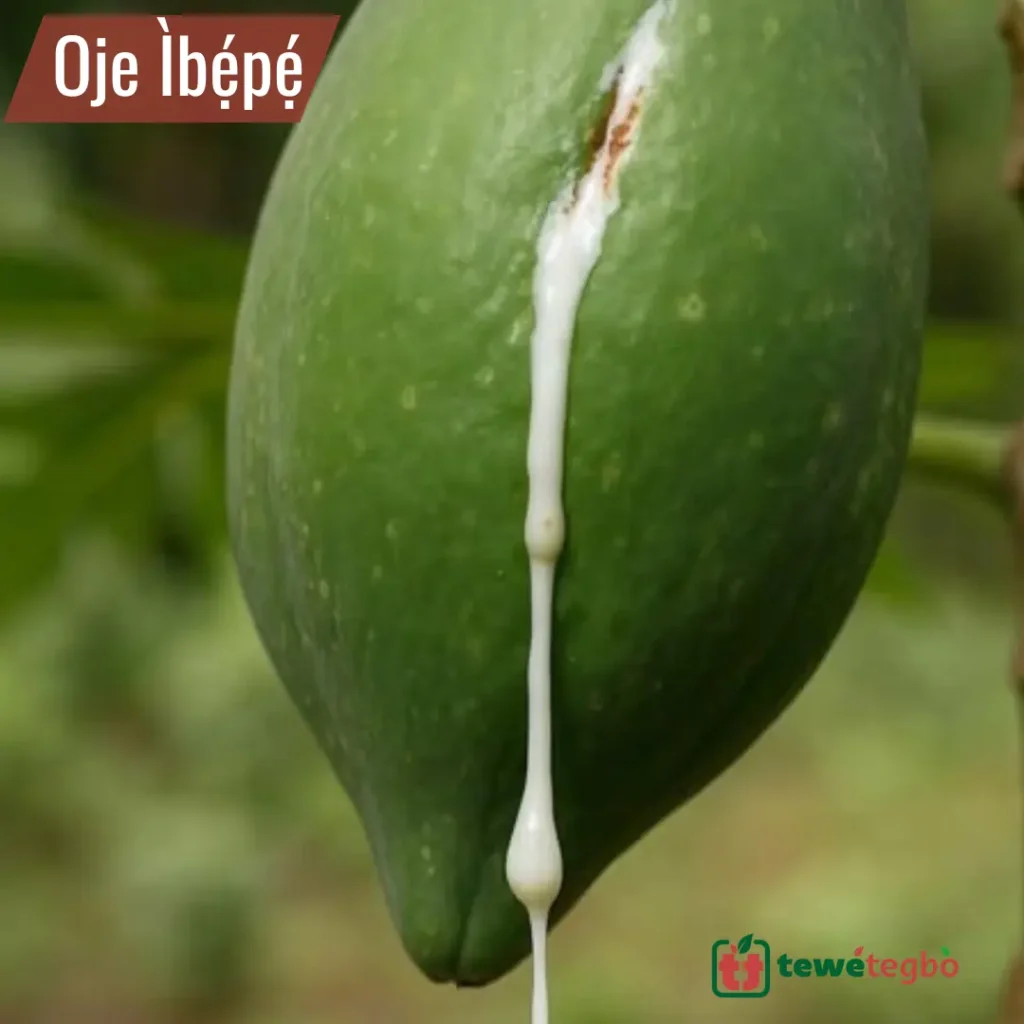
How we use it:
- For skin problems
- For cuts
- For pain
Warning:
Some saps (oje) can burn the skin or harm the eyes.
Be very careful.
9. Ikun (Resin)
Some trees do not bring out white milk.
Instead, they bring out sticky gum-like substance.
That is called Ikun or Ikunmu.
It:
- Comes out slowly
- Is sticky
- Becomes hard after some time
- May have strong smell
Example:
- Ikun Òjìà
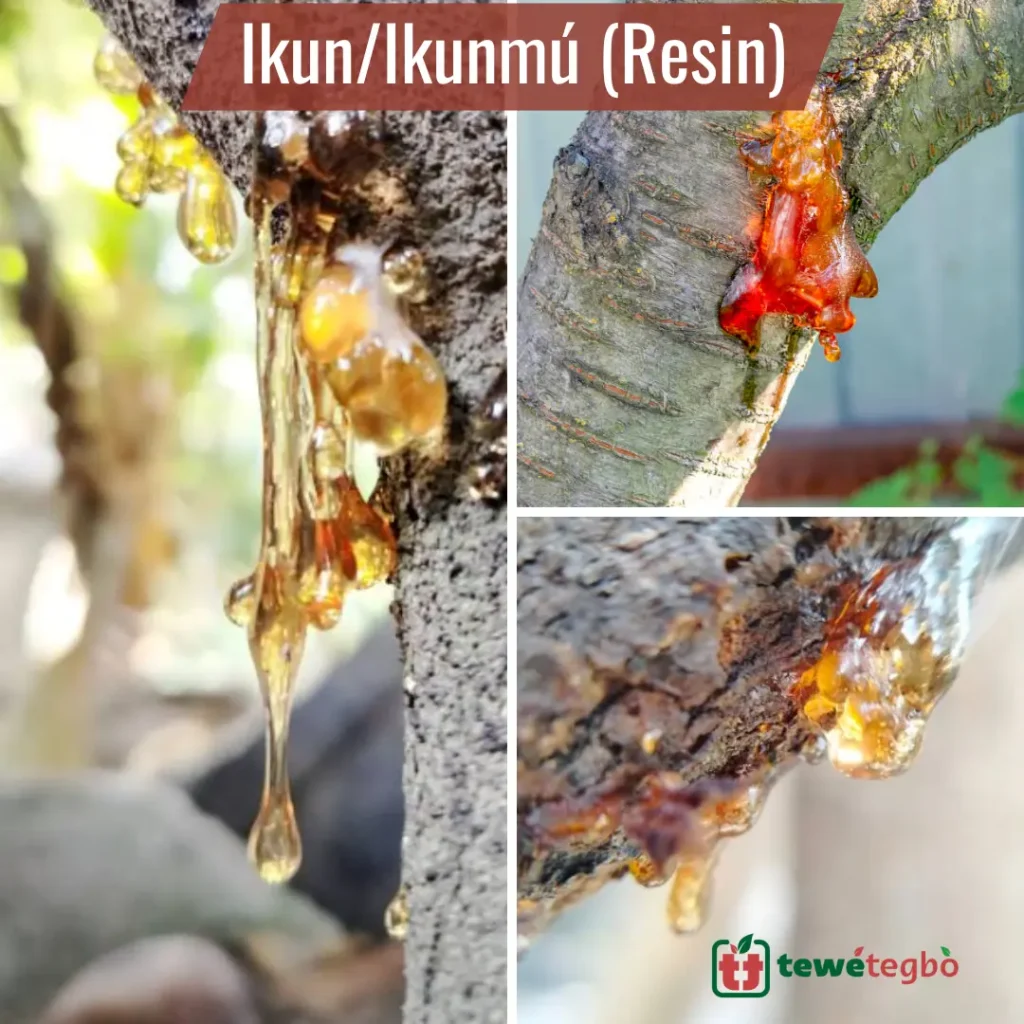
Simple way to know:
- If it runs like milk → Oje
- If it sticks like gum and later becomes hard → Ikun
Ikun (resin) is different from Oje (sap/latex).
Why Plant Parts Matter
The same plant can behave differently depending on:
- Which part you use
- How you prepare it
- How much you take
That is why traditional herbal knowledge is not random as many distant people think.
It follows method.
How Plant Parts are Prepared in Yoruba Herbs (Agbo)
Knowing the right plant part is important.
But knowing how to prepare it is just as important.
In Yoruba herbs, there are different ways to prepare plants.
Some herbs are:
- Drunk as herbal liquid (agbo)
- Added to pap or food
- Taken as powder
- Used for bathing
- Applied on the skin
The way a herb is prepared often depends on:
- The type of sickness
- Where the problem is in the body
- How strong the herb is
For example:
- Skin problems may require bathing or external application.
- Internal sickness may require drinking or powder.
So preparation is not random.
It depends on the condition being treated.
Below are the common ways plant parts are prepared in Yoruba herbs.
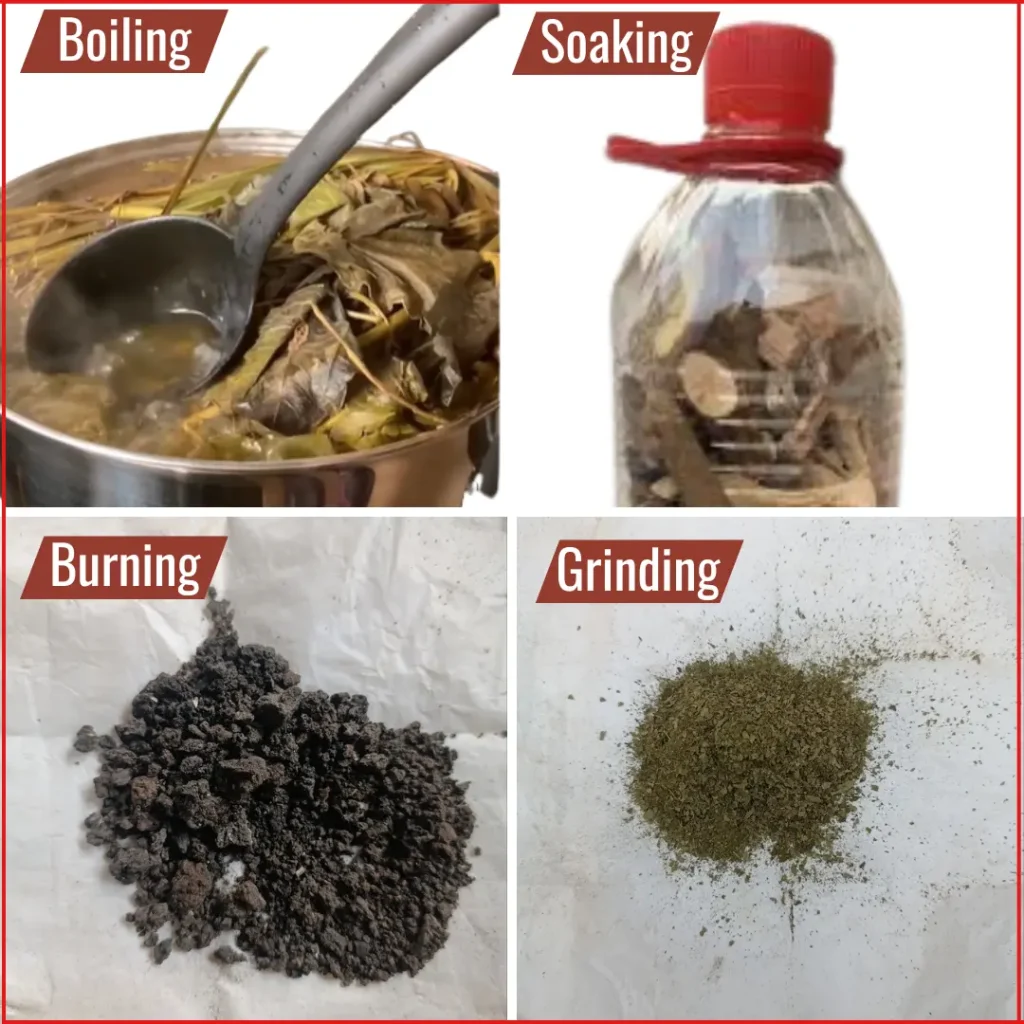
1. Boiling (Sísè)
This is the most common method.
Plant parts are put inside water, corn fermented water (omi ogi) or water got from another herb and boiled.
This is how we make herbal drink (agbo).
Boiling helps to:
- Bring out the useful parts inside the plant
- Soften hard materials like bark and roots
- Mix different herbs together
Leaves, bark, roots, and seeds can all be boiled depending on the instruction.
2. Soaking (Rírẹ)
In this method, the plant part is not boiled.
It is soaked in:
- Clean water
- Warm water
- Honey (for some herbs)
- Vinegar (especially for external use)
It may stay for many hours or days.
Soaking is often used for:
- Bark
- Roots
- Strong herbs
This method slowly brings out the plant’s strength.
3. Burning (Jíjó)
Burning is sometimes used for special herbs.
Not all herbs can be eaten raw.
Some may:
- Cause vomiting
- Taste too harsh
- Be too strong
- Cause reaction when fresh
So they are burned carefully.
Burning can:
- Reduce their sharpness
- Reduce their strength
- Make them easier to consume
After burning, the herb may be:
- Turned into black powder
- Mixed with pap (ogi)
- Added into other mixtures
This must be done carefully.
Not every herb should be burned.
4. Grinding (Lílọ̀)
Grinding means crushing the herb into small pieces or powder.
Some herbs are not easy to take directly.
So they are ground to:
- Make them easier to prepare
- Help extract their medicinal content
- Allow the body absorb them better
In some cases, the ground herb is packed like a tea bag.
Hot water is poured on it to draw out what is inside.
This method is common for:
- Hairy ground plants (Bálẹ̀rẹ́ Onírun)
Grinding helps release what is hidden inside the plant.
How Plant Parts Are Preserved for Later Use
Fresh herbs are often preferred.
But not every plant part is used immediately.
Sometimes:
- The plant is seasonal
- Plants are harvested in larger quantity
- The herb needs to be stored for future preparation
So preservation becomes important.
In Yoruba traditional practice, drying is the main method of keeping plant parts.
1. Sun Drying (Sísá Ní Oòrùn)
In some modern discussions, people say:
“Do not dry herbs under direct sunlight.”
However, in Yoruba traditional practice (Southwest Nigeria) drying under direct sun is common and respected.
The climate in this region is generally warm and moderate.
During the dry season, there is steady sunlight that helps herbs dry properly.
Yoruba elders observed that when herbs are dried properly under sunlight:
- They dry faster
- They do not retain excess moisture
- They store well for long periods
- They maintain their usefulness
There is even a Yoruba saying used jokingly when mocking someone:
“Ẹnu ẹ́ mẹ́tù il̀ẹ̀ bí agunmu inú abà.”
Meaning:
“His mouth smells like herb dried under the roof.”
This proverb reflects a traditional belief:
Herbs dried without enough sun may:
- Smell stale
- Retain hidden moisture
- Spoil faster
So sun drying became the trusted method in this environment.
This practice developed from long-term observation, not guesswork.
2. Shade or Roof Drying (Used When Necessary)
Drying under shade or roof is also practiced.
But traditionally, it is used mainly:
- During heavy rainy season
- When sunlight is unavailable
- When weather is too humid
In prolonged rainy periods, direct sun may not be accessible.
So herbs are dried indoors or under covered space.
However, elders often observed that if drying under the roof takes too long:
- The herb may develop odor
- Insects may enter
- Storage life may reduce
Because of this experience, sun drying remained the preferred option whenever weather allows.
Traditional Understanding of Preservation
Fresh herb → Active and immediate
Properly sun-dried herb → Preserved and stable
Poorly dried herb → Weak or spoiled
The goal is not just to remove water.
The goal is to preserve usefulness.
Understanding How Different Plant Parts Work
In Yoruba traditional medicine, there is an important teaching.
Our fathers say:
- Root is stronger than bark.
- Bark is stronger than leaves.
But when we talk about how fast it works in the body:
- Leaves work faster than bark.
- Bark works faster than root.
So we have two things:
- Strength
- Speed
They are not the same.
Why Root Is Considered Stronger
Roots grow inside the ground.
They:
- Hold the plant firmly
- Drink deep from the soil
- Store strong substances
Because of this, roots are believed to:
- Work deeply inside the body
- Handle stubborn or long sickness
But roots are used carefully.
Usually in small quantity.
Why Bark Is In Between
Bark is the skin of the tree.
It protects the tree and carries strength between root and leaf.
Traditional belief says:
- Stronger than leaf
- Not as strong as root
Bark is often used for:
- Long-standing sickness
- Strengthening mixtures
Why Leaves Act Faster
Leaves are softer.
They release their contents quickly when:
- Boiled
- Squeezed
- Soaked
Because of this, leaves are believed to:
- Act faster in the body
- Give quicker response
But they may not go as deep as roots.
Simple Traditional Understanding
| Plant Part | Strength | Speed |
|---|---|---|
| Leaves | Light | Fast |
| Bark | Medium | Medium |
| Root | Strong | Slow |
So:
- If quick relief is needed → leaves may be used.
- If deep or stubborn issue → root may be used.
- If something is in between → bark may be used.
Important Note
This teaching comes from traditional experience. Though, different plants behave differently.
Preparation method also matters.
Modern science studies plants in another way, but many traditional observations are still being studied today.
What Next?
Knowing the parts of a plant is one step.
The next step is knowing:
- Which herb is which
- What each one is called in English
- And what they are used for
I have arranged them in one place.
👉 See the complete list here:
Yoruba Herbs and Their English Names
And if you want to understand how Yoruba traditionally group and classify plants, you can also read:
👉 Yoruba Plant Classification System